About the Art
Find the images used across this site, what each one means, and where to see it.
Featured artwork
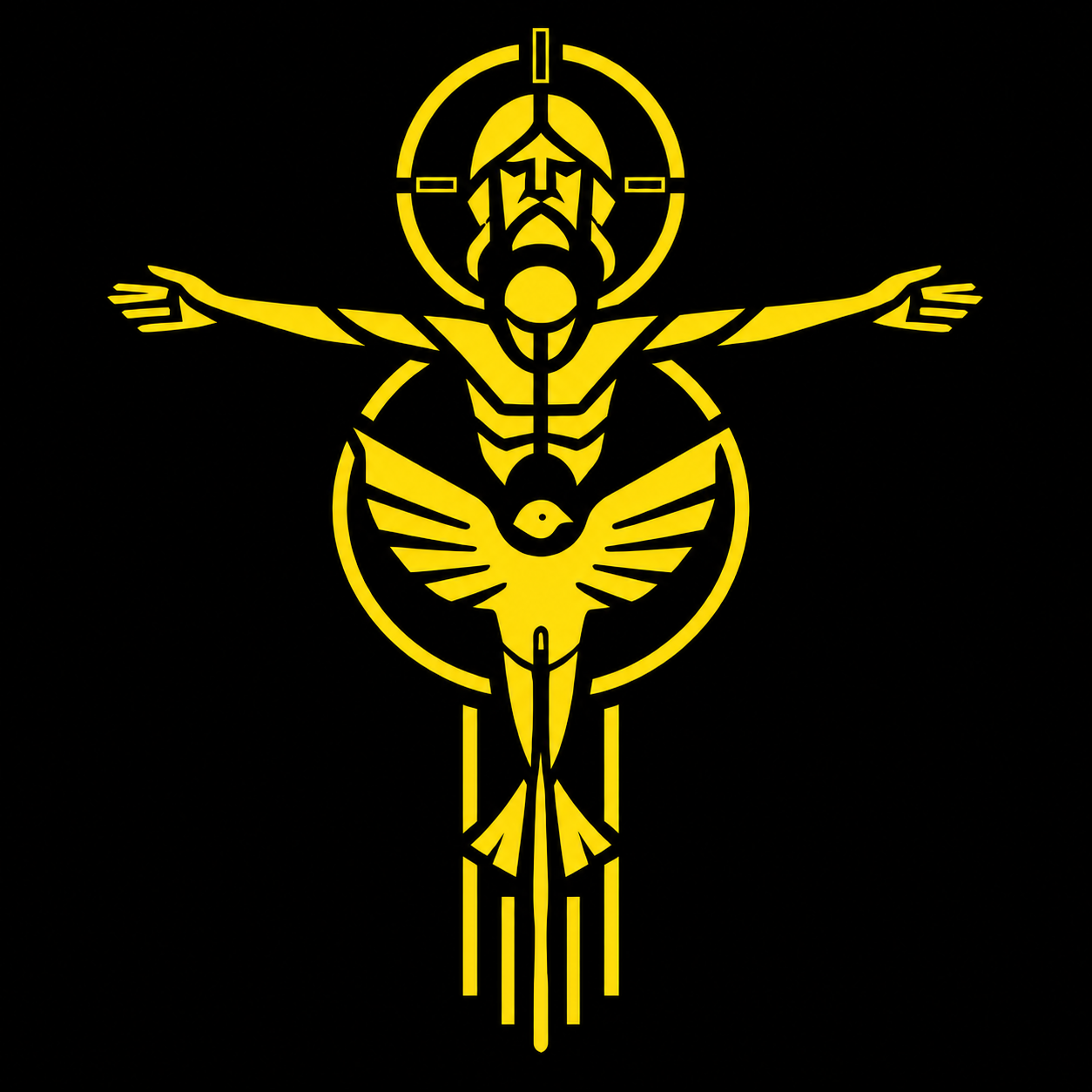
The golden Trinity emblem
The Father, the Son with his arms extended, and the dove of the Holy Spirit share a single design. The outstretched arms recall the Cross. The dove recalls Jesus’ baptism, when the Spirit descended and the Father’s voice named Jesus his beloved Son.
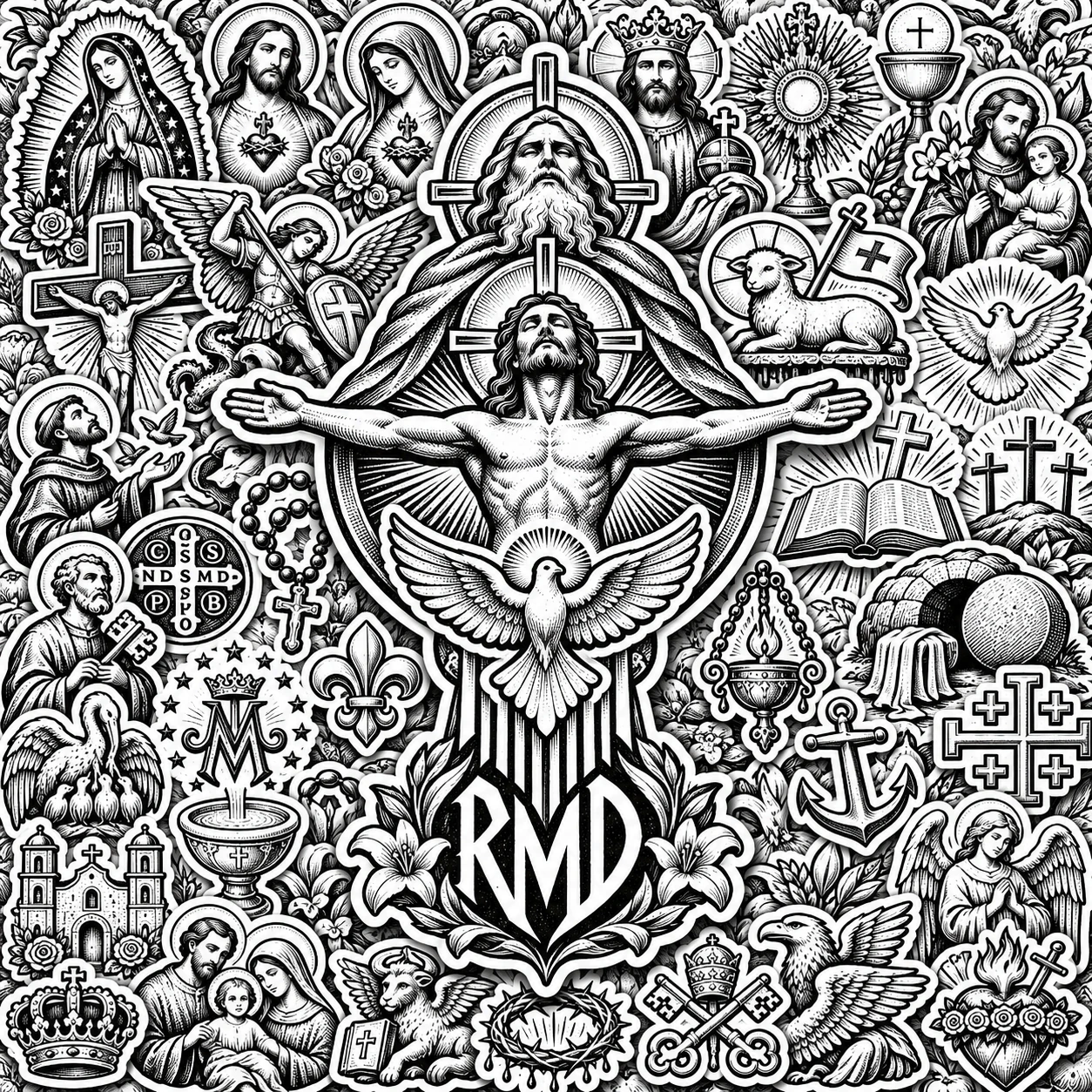
The Trinity devotional collage
The Trinity holds the center. Around it are the Cross and empty tomb, Mary and the saints, Scripture, the sacraments, and signs of prayer and hope. The arrangement gathers the ordinary practices of Christian life around the God who gives that life.
Emblems around the site
The pelican in her piety
In a medieval legend, the pelican pierces her breast to feed her young with her own blood. Christians saw in her an image of Christ’s sacrifice on the Cross and his gift of himself in the Eucharist. The hymn Adoro te devote calls Jesus the loving pelican.
The open Bible and Cross
The open book invites us to hear and study Scripture. The cross above its pages points to Christ, the center of the story the Scriptures tell. This engraving serves as the site’s mark in the header.
Seen onThe chalice and Host
The chalice and Host point to the Eucharist. The grapes recall the wine of the cup, and the cross on the Host recalls Christ’s offering of himself. At Mass the Church receives his Body and Blood.
The dove of the Holy Spirit
At Jesus’ baptism the Spirit descends like a dove. The image also recalls the Spirit’s gift to the baptized. On the salvation page it marks the grace by which we receive a share in God’s life.
Saint Francis and the birds
The birds recall the story of Francis of Assisi preaching to them and his habit of praising God through creation. In the salvation essay he marks the section on Bonaventure, whose Franciscan theology follows the soul’s return to God through Christ.
The empty tomb
The stone has been rolled away. In the Gospel, the women find the tomb open and hear that Jesus has risen. The engraving marks Christ’s Resurrection and the hope that our own bodies will be raised.
The church façade
The building represents the Church gathered for worship. Its cross and doorway bring to mind a place where people hear the word, pray together, and receive the sacraments. It marks the Catholic teaching resources.
Seen onThe engraved Trinity
The figures of the Father, the crucified Son, and the dove of the Spirit form one engraving. It brings the Cross into view within the life and saving work of the one God, Father, Son, and Holy Spirit.
The engraving sheet
The engravings share the initials RMD for Robert Moses Dryer. The original sheet shows all 36 together. The remaining pieces are grouped below by subject.
Open the complete engraving sheet
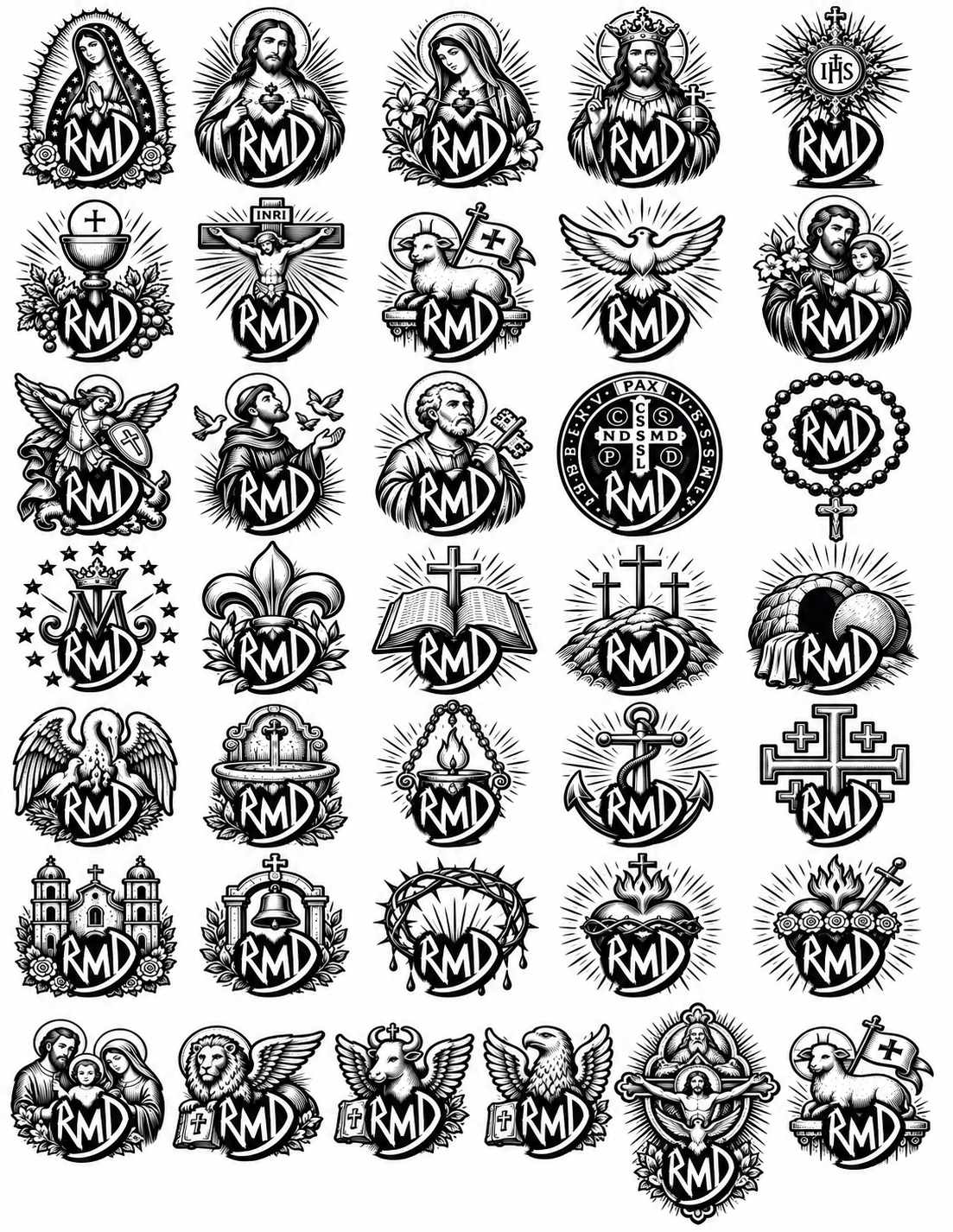
Browse all 36 engravings by image
Christ and the sacraments
The Crucifix
Christ on the Cross makes his suffering and self-offering visible. The letters above him recall the inscription naming him Jesus of Nazareth, King of the Jews.
The Lamb of God
John the Baptist names Jesus the Lamb of God who takes away the sin of the world. The cross behind the lamb brings that title into view alongside Christ’s sacrifice.
The victorious Lamb
The second Lamb engraving carries the same cross banner. The banner draws out the theme of victory in Revelation, where the Lamb who was slain stands alive and receives worship.
Christ showing his Sacred Heart
Christ directs attention to his own heart. The gesture invites us to consider the love of Jesus himself, seen in his human life and in his offering on the Cross.
The Sacred Heart of Jesus
The heart makes Christ’s human and divine love visible. The flames suggest the ardor of that love. The cross and thorns recall its cost in the Passion.
Christ the King
The crown and the globe topped with a cross signify Christ’s kingship over creation. The raised hand gives a blessing.
The monstrance
A monstrance displays the consecrated Host for Eucharistic adoration. The radiating lines draw the eye toward Christ at the center of that prayer.
The three crosses at Calvary
Jesus dies between two others. The three crosses recall the man beside him who turns to him and hears a promise of paradise.
The crown of thorns
The soldiers crown Jesus with thorns in mockery. In Christian devotion the crown keeps his suffering in view alongside his kingship.
The baptismal font
The basin recalls the water of Baptism. The cross links that washing to Christ’s death and Resurrection, into which the baptized are drawn.
The sanctuary lamp
The flame recalls the lamp kept burning near the tabernacle to honor and signal Christ’s presence in the reserved Eucharist.
Mary and the saints
Our Lady of Guadalupe
The starry mantle and rays recall the image associated with Saint Juan Diego at Tepeyac. The roses recall the flowers he carried to the bishop.
Mary with her Immaculate Heart
The portrait shows Mary’s heart beside lilies. Her lowered gaze recalls the Mary of Luke’s Gospel, who keeps the events of Jesus’ life and ponders them in her heart.
The Immaculate Heart of Mary
The flames and roses evoke Mary’s love. The sword recalls Simeon’s prophecy that a sword would pierce her soul, a sign of the sorrow she would share in her Son’s suffering.
The crowned Marian monogram
The letter M names Mary. The crown and stars recall the woman crowned with stars in Revelation, an image read in Catholic tradition in relation to both Mary and the Church.
The fleur-de-lis
The three-petalled design is a stylized lily. In this collection it echoes the lilies associated with Mary and Saint Joseph.
Saint Joseph and the Child Jesus
Joseph holds the child entrusted to his care. The lilies are a traditional sign of his chastity, and the closeness of the two figures shows his fatherly care for Jesus.
The Holy Family
Jesus, Mary, and Joseph share the life of a household. The image recalls Jesus’ years in Nazareth and the holiness of ordinary family life.
Saint Michael the Archangel
Michael stands over the dragon with a sword and shield. The scene recalls the battle in Revelation, where Michael and his angels oppose the dragon.
Saint Peter and the keys
The keys recall Jesus’ promise to give Peter the keys of the kingdom of heaven. They mark the responsibility Christ entrusts to him.
Scripture, prayer, and hope
The Rosary
The beads give a rhythm to prayer. They help the person praying stay with the events of Christ’s life, death, and Resurrection in the company of Mary.
The Saint Benedict Medal
The round engraving recalls the medal’s cross and the word Pax, meaning peace. The letters on the traditional medal abbreviate prayers for protection and strength in temptation.
The anchor of hope
The Letter to the Hebrews compares hope to an anchor for the soul. The engraving gives that image a cross, pointing to Christ as the ground on which Christian hope rests.
The Jerusalem Cross
The large cross and four smaller crosses form an emblem of the Holy Land. The Franciscan Custody records a traditional reading in which the five crosses recall Christ’s five wounds.
The church bell
The bell makes the call to worship audible beyond the church walls. It recalls the shared hours of Mass and prayer.
Saint Mark’s winged lion
The winged lion is the traditional emblem of Mark the Evangelist. The book beside it identifies his witness as a Gospel.
Saint Luke’s winged ox
The winged ox is the traditional emblem of Luke the Evangelist. The ox evokes sacrifice, fitting a Gospel that begins in the Temple with Zechariah at prayer.
Saint John’s eagle
The eagle is the traditional emblem of John the Evangelist. Its flight suits a Gospel that opens with the Word already with God in the beginning.